When comparing mutual funds, investors often look at the return shown for one, three or five years and assume it tells the complete story. It does not. A fund’s performance can look very different depending on the period selected.
This is where rolling returns of mutual funds can provide a more useful perspective than a single point-to-point number.
What are point-to-point returns?
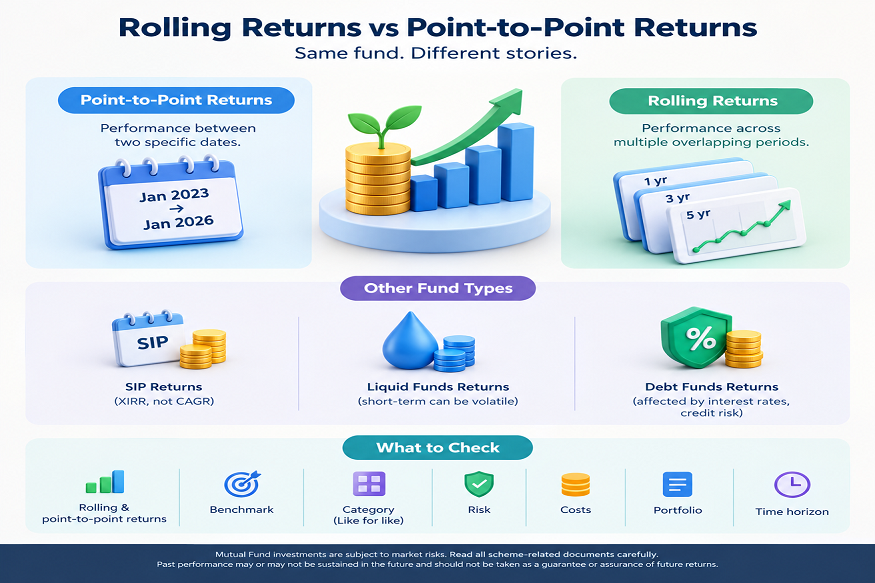
Point-to-point returns measure how an investment performed between two specific dates.For example, if you check a fund’s performance from 1 January 2023 to 1 January 2026, the calculation tells you what happened during that particular three-year period. If annualised, the result is generally expressed as CAGR.
The limitation is timing. Starting just before a strong market rally or a major correction can materially influence the result. Two investors reviewing the same fund on different dates could therefore see very different point-to-point returns.
That does not make point-to-point returns useless. They can help answer a specific question: “How did the fund perform during this particular period?”
What are rolling returns?
The problem of time is dealt with by using rolling returns, which use returns over many periods. For instance, suppose your objective is to measure three-year performance. Rolling returns will measure the three-year return not just for one three-year period but over many potential start dates that exist in the past.
For instance, although a fund may have an appealing three-year CAGR, its rolling three-year experience may indicate varying results depending on the starting date. The distinction is important when evaluating consistency. Rolling returns therefore answer a different question: “How consistently has the fund performed across different investment periods?”
Rolling returns vs point-to-point returns
The two measures are complementary rather than competing.
| Measure | What it tells you | Main limitation |
| Point-to-point | Performance between two selected dates | Sensitive to entry and exit dates |
| Rolling returns | Performance across multiple overlapping periods | Requires a sufficiently long history |
| SIP returns | Experience across multiple cash flows | Not directly comparable with a lump-sum CAGR |
For mutual fund evaluation, rolling returns can provide more context, particularly when comparing a fund with its appropriate benchmark and category peers. SEBI’s current mutual fund framework requires benchmark performance to be disclosed alongside scheme performance for the same period in prescribed performance disclosures.
What about mutual funds SIP returns?
Mutual funds SIP returns should not be judged using the same method as a single lump-sum investment.
With a SIP, money is invested on different dates and at different NAVs. Consequently, each instalment has a different holding period. SIP performance is commonly evaluated using an internal-rate-of-return approach such as XIRR, which accounts for the timing of individual cash flows.
A fund’s five-year lump-sum CAGR and a five-year SIP return can therefore differ without either calculation being incorrect.
How should you assess liquid and debt funds?
For liquid mutual funds returns, the investment horizon is particularly important. Short-period performance can be affected by prevailing money-market conditions, portfolio accruals and other factors. Annualising a very short period can also create an impression that may not represent a sustainable longer-term outcome.
In addition, returns of debt funds depend on various elements like interest rate changes, credit ratings of portfolios, and maturity of the portfolios. During a period of declining interest rates, the market value of bonds will be different from that during an era of increasing interest rates.
This is the reason why people should analyze several periods and the benchmarks of the fund instead of choosing any debt or liquid fund because of high returns in recent periods.
A practical checklist for investors
When evaluating a mutual fund, look at:
When analyzing a mutual fund, consider:
- Rolling returns: Determine consistency over relevant time periods.
- Point-to-point returns: Learn about the performance of the fund during particular market cycles.
- Benchmark: Assess the fund against the relevant benchmark within the same time frame.
- Comparison of Category: Compare apples with apples, not apples with oranges.
- Risk: Consider volatility risk, credit risk, and interest rate risk where necessary.
- Cost: Analyze the expense ratio of the scheme, among others.
- Portfolio: Know the composition of the fund.
- Time horizon: Match the fund’s risk profile with your financial goal.
AMFI’s investor guidance also recommends using the fund fact sheet, which typically contains performance, benchmark, expense ratio and portfolio information.
The bottom line
Point-to-point returns provide a snapshot; rolling returns provide a broader view of consistency. Neither should be treated as a forecast of future performance.
For a more informed assessment, examine rolling and point-to-point returns together, compare them with the appropriate benchmark and understand the risks behind the numbers. Most importantly, remember that past performance does not guarantee future results. Mutual fund investments can lose value, and the principal invested is not guaranteed.
Risk disclosure: Mutual Fund investments are subject to market risks, including possible loss of principal. Read all scheme-related documents carefully before investing. Past performance may or may not be sustained in the future and should not be taken as a guarantee or assurance of future returns.