
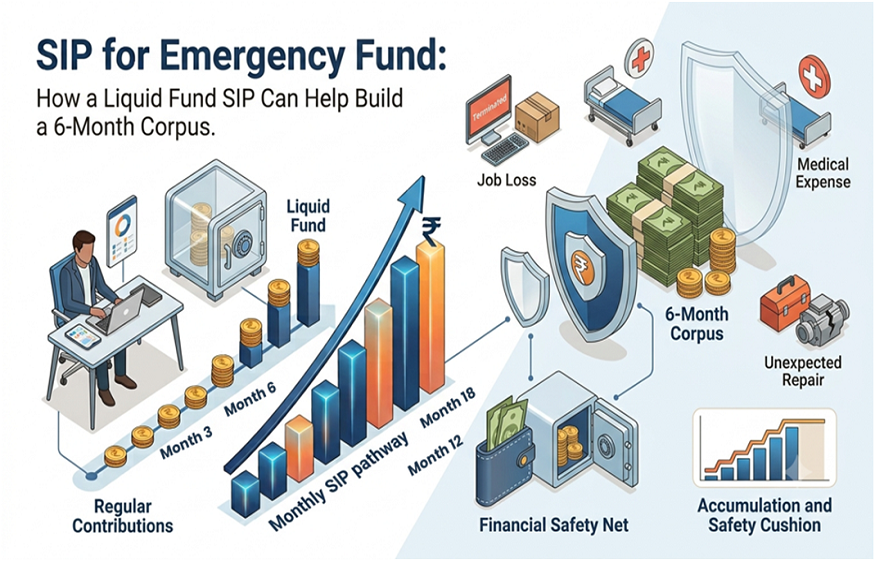
An emergency fund is one of the basic building blocks of financial stability. It provides a financial cushion when unexpected events such as job loss, medical expenses, urgent repairs or temporary income disruption occur. However, simply deciding to maintain an emergency fund is not enough. The bigger question is how to build the required corpus without making the process difficult to follow.
A Liquid fund SIP can offer a disciplined approach to building this reserve. For individuals with a defined timeline, a liquid fund SIP may be considered as one possible route, provided the investment’s risk, liquidity and suitability are understood.
Start With a 6-Month Emergency Corpus
A practical starting point is to estimate essential monthly expenses rather than total lifestyle spending.
Suppose your essential expenses are ₹50,000 per month. A six-month emergency corpus would be:₹50,000 × 6 = ₹3 lakh
This ₹3 lakh should ideally cover necessities such as rent, food, utilities, insurance premiums, loan EMIs and other unavoidable expenses.The six-month figure is not a universal rule. Someone with a stable salaried job and dual household income may have different requirements from a freelancer, single-income household or person with significant financial commitments.
Why Consider a Liquid Fund SIP?
Liquid funds are debt mutual fund schemes that primarily invest in short-term money-market and debt instruments. Their relatively short-duration portfolio makes them different from equity-oriented mutual funds, which can experience substantial market fluctuations.For an emergency fund, liquidity and capital stability are generally more important than pursuing high returns. A liquid fund may therefore be considered when an investor wants an alternative to keeping the entire reserve in a traditional savings account.
However, a liquid fund is still a mutual fund investment. Its returns are not guaranteed, and the value can fluctuate. It should not be treated as equivalent to a bank deposit.
Build the Corpus Systematically
Suppose your target emergency fund is ₹3 lakh and you currently have no dedicated reserve. Instead of trying to accumulate the entire amount at once, you could divide the goal into manageable monthly contributions.
For illustration, a sip calculator can help estimate the monthly investment required based on your ₹3 lakh target, 18-month investment period and an assumed annualised return of 6%. Under these assumptions, you would need to invest roughly ₹15,500 per month.
The actual amount required may differ because mutual fund returns are market-linked and do not follow a fixed rate. The objective of the SIP is primarily discipline and regularity, rather than maximising investment returns.
Don’t Wait Until the Emergency Fund Is Complete
An emergency fund is intended to protect your finances when something unexpected happens. Therefore, waiting 18 months with no accessible reserve may defeat its purpose.If you currently have no emergency savings, consider building an initial cash buffer first. For example, you might prioritise creating one month of essential expenses in a readily accessible savings account and then continue building the larger six-month reserve.
Once the basic buffer exists, regular contributions toward the remaining target can make the process more manageable.
Keep Liquidity Ahead of Returns
The purpose of an emergency fund is different from that of long-term wealth creation. Equity funds may potentially generate higher long-term returns, but their short-term volatility makes them less suitable for money that may be required unexpectedly. Similarly, locking emergency savings into investments with limited liquidity may create problems when the money is needed urgently.
A liquid fund can be one component of an emergency-fund strategy, but investors should understand the scheme’s redemption process, applicable exit load rules, taxation and other terms before investing.
Review the Corpus Regularly
Your emergency-fund requirement will not necessarily remain constant. If your rent increases, you take a new loan, your family responsibilities change or your monthly essential expenses rise, the six-month target should be recalculated.
For example, if essential expenses increase from ₹50,000 to ₹60,000, a six-month corpus would rise from ₹3 lakh to ₹3.6 lakh.
Therefore, review your SIP for emergency fund periodically and increase the monthly contribution when your income allows.
Emergency Fund First, Returns Second
An emergency fund is fundamentally about financial resilience. The objective is to ensure that an unexpected expense does not force you to borrow at high interest rates or liquidate long-term investments at an inconvenient time.A liquid fund SIP can provide a systematic way to work toward a six-month corpus, but the strategy should prioritise accessibility, suitability and adequate liquidity over chasing returns.
The key is simple: estimate essential expenses, set a realistic six-month target, build an accessible initial buffer, contribute regularly and review the corpus as your financial circumstances change.
Disclaimer: This article is for educational purposes only and should not be considered investment advice. Mutual fund investments are subject to market risks, and returns are not guaranteed. Investors should assess scheme features, liquidity, taxation and their individual circumstances before investing.